


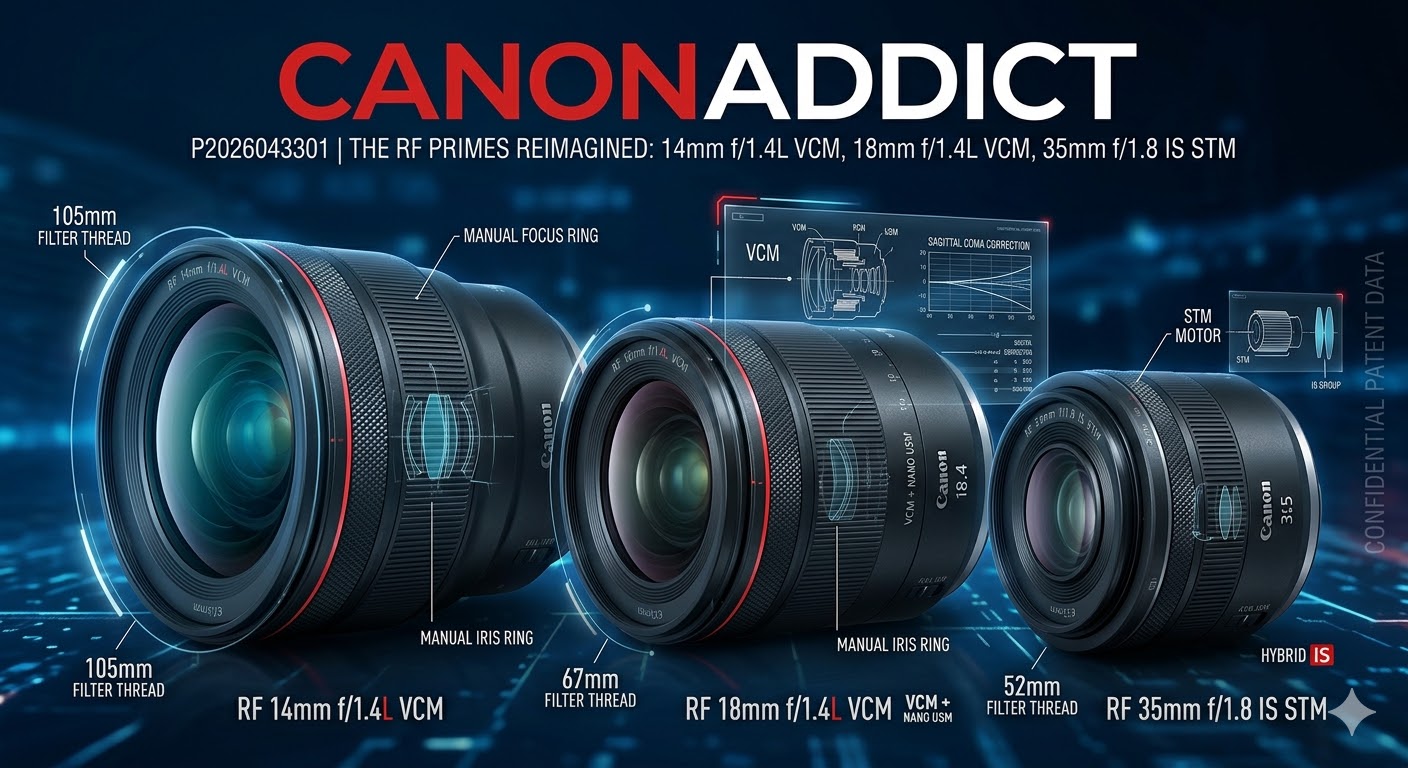
Canon patent P2026043301 has been found, which covers Canon 14mm f/1.4, 18mm f/1.4, and 35mm f/1.8 lenses. Below is a summary of the patent; you can also view it here on j-platpat.
Patent Analysis: Canon P2026-043301 Details New 14mm f/1.4, 18mm f/1.4, and 35mm f/1.8 RF Primes
Canon’s latest patent application out of Japan, P2026-043301 (published March 12, 2026), provides a transparent look at the optical engineering driving the next phase of the RF mount. The filing outlines three distinct wide-angle prime formulas: a 14mm f/1.4, an 18mm f/1.4, and a 35mm f/1.8.
More than just a list of focal lengths, the physical dimensions and optical complexities detailed in this patent confirm Canon’s strategy to standardize their primes for hybrid (stills and video) workflows.
Here is a breakdown of the specific embodiments and the engineering logic behind them.
The Engineering Context: Why VCM for the Ultra-Wides?
Before analyzing the specific lenses, the f/1.4 formulas in this patent must be viewed through the lens of Canon’s Voice Coil Motor (VCM) strategy.
Fast, ultra-wide primes require heavy, complex optical groups to correct for coma and distortion. Traditional Ring USM (Ultrasonic Motor) generates rotational force that translates to linear movement via mechanical gears or helicoids. While excellent for stills, this mechanical translation introduces micro-jitters and acoustic noise during continuous video autofocus.
VCM, paired with Nano USM, provides a direct magnetic linear drive. This allows Canon to glide massive f/1.4 focusing groups silently and fluidly. It also facilitates precise electronic breathing compensation. The 130mm and 121mm lengths of the 14mm and 18mm designs in this patent clearly indicate the physical space required to house this dual-motor VCM architecture, matching the footprint of the existing 24mm, 35mm, and 50mm VCM lenses.
Embodiment 1: RF 14mm f/1.4L VCM
Canon already dominates the ultra-wide zoom space, but an f/1.4 prime at 14mm is a specialized tool engineered primarily for astrophotography and architectural work.
- Focal Length: 14.30mm
- F-Stop: f/1.45
- Half Angle of View: 56.71°
- Total Lens Length: 130.00mm
Analysis: The 130mm physical length accommodates a heavily bulbous front element necessary to gather light across a 114° total field of view. The optical diagram reveals a dense cluster of rear elements. This is a classic hallmark of designs utilizing large-diameter GMo (Glass-Molded) aspherical glass to force light rays to strike the sensor perpendicularly, aggressively correcting the sagittal coma flare that plagues wide-open astrophotography.
Embodiment 2: RF 18mm f/1.4L VCM
This is a historic focal length for Canon. While 18mm is a standard in the APS-C and cinema worlds, Canon has traditionally skipped it in their full-frame stills lineup in favor of 14mm, 20mm, and 24mm.
- Focal Length: 18.45mm
- F-Stop: f/1.46
- Half Angle of View: 49.33°
- Total Lens Length: 121.17mm
Analysis: At 121.17mm, this lens fits the exact physical profile of the current f/1.4L VCM series, making it instantly swappable on a gimbal without rebalancing. The 18mm focal length fills a critical gap for hybrid shooters: it is wide enough for immersive vlogging and environmental portraits without inducing the severe perspective stretching seen at 14mm. To achieve f/1.4 in a 121mm barrel, this design likely relies heavily on digital distortion correction profiles rather than purely optical correction.
Embodiment 3: RF 35mm f/1.8 (Internal Focus Redesign)
The inclusion of a 35mm f/1.8 is the most revealing aspect of this patent regarding Canon’s consumer lens strategy, as the RF 35mm f/1.8 Macro IS STM already exists.
- Focal Length: 33.95mm
- F-Stop: f/1.85
- Half Angle of View: 32.55°
- Total Lens Length: 96.88mm
Analysis: The current RF 35mm f/1.8 is an older, external-focusing design where the front barrel extends. This shifts the center of gravity and prevents the use of clamp-on matte boxes—both dealbreakers for video production. The 96.88mm formula in this patent strongly points to an internally focusing Mark II redesign. By utilizing a smaller, lighter internal focus group, Canon can significantly speed up autofocus, eliminate external movement, and bring their popular consumer prime up to modern hybrid standards.