


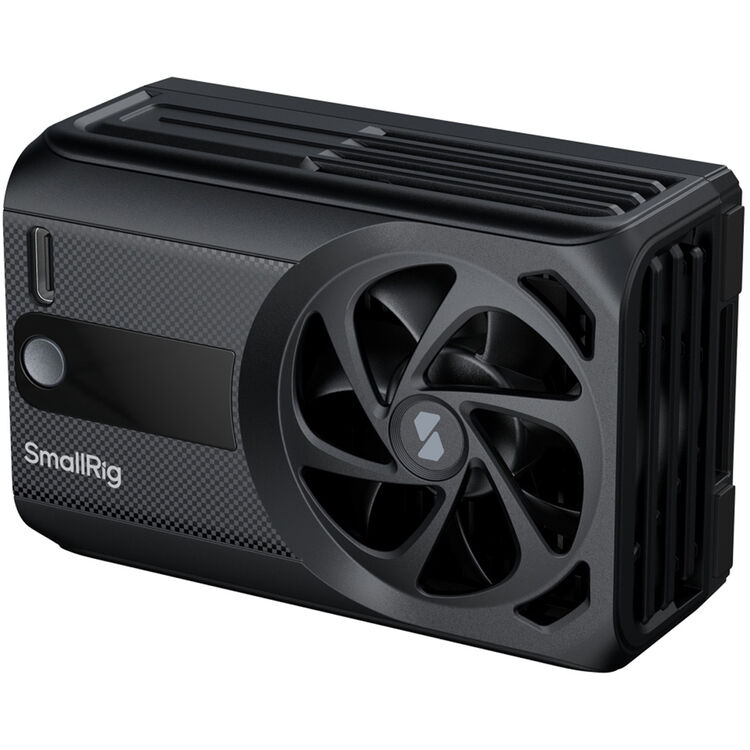
SmallRig Hybrid Cooling Fan for Mirrorless Cameras
SmallRig Cooling Fan for Mirrorless Cameras
SmallRig Launches Universal Cooling System for Canon Mirrorless Cameras: Meet the Hybrid 5328 and Basic 5329
SmallRig has officially unveiled its new Universal Cooling System for mirrorless cameras, aimed at Canon shooters who push long-form 4K, 8K, and high-frame-rate recording to the point where heat becomes a limiting factor. The lineup ships in two versions — the Hybrid Cooling 5328 and the Basic Cooling 5329 — both designed to snap onto the back of the camera in place of the flipped-out LCD to pull heat away from the body during extended sessions.
Unlike SmallRig’s earlier model-specific coolers, this new generation is built as a universal platform. It covers key cameras in Canon’s mirrorless lineup, including the EOS R5, EOS R5 Mark II, EOS R6 Mark II, and EOS R7, with compatibility also extending to several Sony bodies.
The key question for most buyers will be which of the two to pick. Here is how they break down:
1. Cooling architecture The fundamental split between the two models is the presence — or absence — of a semiconductor (TEC) cooling module.
- SmallRig 5328 (Hybrid Cooling): Combines a 7000 rpm high-speed fan with a TEC semiconductor cooling module, giving it the ability to actively drive surface temperature below ambient rather than just moving air across the body. This is the model to reach for in genuinely demanding conditions — long takes, warm environments, or codec-heavy 8K/4K formats where a fan alone struggles.
- SmallRig 5329 (Basic Cooling): Uses the same 7000 rpm fan but skips the TEC module, relying purely on airflow. It is better suited to moderate shooting conditions where the goal is simply to keep the camera from tipping over its overheating threshold.
2. Operating modes
- 5328 Hybrid: Three-speed operation with Auto, High, and Low modes, letting shooters balance cooling intensity against runtime and noise.
- 5329 Basic: Two-speed operation, reflecting its simpler fan-only design.
3. Battery life Both units feature a built-in rechargeable battery and support charging while in use — a meaningful detail for anyone running long event or interview shoots.
- 5328 Hybrid: Up to approximately 70 minutes at maximum power (built-in 2200mAh battery). The TEC module is the trade-off; it cools harder but draws significantly more energy.
- 5329 Basic: Up to approximately 180 minutes at maximum power (built-in 1100mAh battery), prioritizing endurance over peak cooling capability.
4. Size and weight The two units share the same footprint but differ slightly in thickness and mass.
- Shared footprint: Roughly 85 × 50.8 mm, constructed from PC material and aluminum alloy.
- 5328 Hybrid: Approximately 32.8 mm deep, 130 g.
- 5329 Basic: Approximately 25 mm deep, 85 g — noticeably slimmer and lighter on the rig.
5. Mounting and compatibility Both models use a spring-loaded, snap-in mounting design that sits behind the flipped-out LCD, allowing for quick attach/detach. It works seamlessly with either caged or cage-free setups. On the Canon side, SmallRig officially lists compatibility with the EOS R5, EOS R5 Mark II, EOS R6 Mark II, and EOS R7.
6. Protections Both units include multiple layers of protection — overheating, short-circuit, and overvoltage — covering the usual safety bases for an active-cooling accessory drawing power near the camera body.
7. Pricing
- SmallRig 5328 Hybrid Cooling: $65
- SmallRig 5329 Basic Cooling: $44
8. Which one should you buy? The decision largely comes down to how hard your camera is being pushed.
Choose the 5328 Hybrid if you are shooting 8K, 4K120, or long-form high-bitrate internal recording on a camera that is known to hit thermal walls — the EOS R5 and EOS R6 Mark II being typical candidates — or if you routinely shoot outdoors in warm environments.
Choose the 5329 Basic if your workflow is less thermally punishing, if you value a lighter and slimmer unit on your rig, or if you simply need the extended 180-minute runtime for long events where swapping power banks on a cooler mid-shoot is not practical.
Follow Canonaddict on Facebook, X/Twitter, Instagram, and YouTube
via SonyAddict