


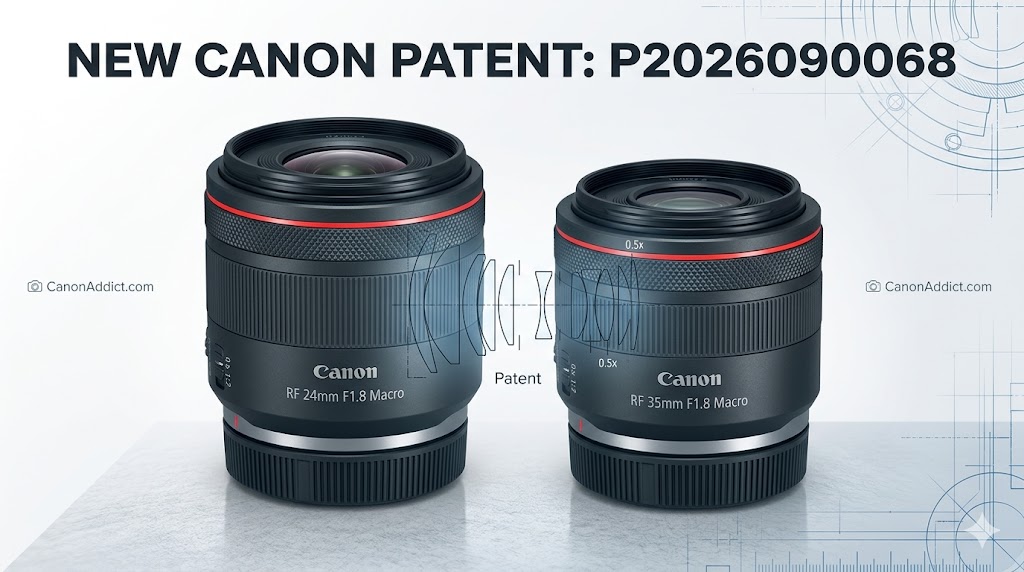
Canon has filed patent P2026-090068, revealing a major redesign for future 24mm and 35mm f/1.8 Macro lenses that swaps current telescoping barrels for a more robust, gimbal-friendly internal focusing system.
Canon Patent P2026-090068: The End of the Telescoping Macro?
A major evolution for Canon’s popular wide-angle and standard “macro” primes has surfaced in Japanese Patent Publication No. 2026-090068. This patent outlines high-performance optical blueprints for 24mm and 35mm f/1.8 Macro lenses that address the primary mechanical complaints of the current RF generation: the externally extending focus barrel.
Internal Focus: A Win for Gimbal Users and Longevity
The most significant shift in these new designs is the move to a fully internal focusing system. In the current RF 24mm and 35mm f/1.8 lenses, the front barrel extends significantly when focusing closely—up to 17mm. This physical shift can throw motorized gimbals out of balance and creates an “air-pumping” effect that can draw dust into the lens.
The new patent blueprints maintain a static physical length regardless of focus distance, resolving center-of-gravity issues and allowing for significantly better environmental sealing.
Technical Breakdown of the New Designs
The patent details four distinct optical embodiments, all optimized for a constant f/1.85 aperture (marketed as f/1.8) and a 1:2 (0.5x) macro magnification.
| Feature | Embodiment 2 (Target: ~24mm) | Embodiment 3 (Target: ~35mm) |
|---|---|---|
| Equivalent Focal Length | 24.50 mm | 34.80 mm |
| Aperture | f/1.85 | f/1.85 |
| Total Optical Length | 112.45 mm | 119.33 mm |
| Max Magnification | 0.5x | 0.5x |
| Image Circle | Ø 40 mm | Ø 40 mm |
The “Sandwiched” Floating Focus System
To maintain sharpness from infinity down to macro distances, Canon is using a complex five-group optical layout. Only two small lens groups move during autofocus, “sandwiched” between stationary front and rear glass. This system is designed to:
- Eliminate Focus Breathing: Ensuring the frame remains stable during rack focuses in video.
- Optimize STM Performance: By moving smaller, lighter glass elements, the Stepping Motor (STM) can focus faster and more quietly than in the current extending designs.
- Maintain 0.5x Macro: The patent confirms that the highly valued 1:2 macro ratio remains a core feature despite the move to internal focus.
Software-Assisted Optics
Interestingly, all embodiments in this patent utilize a 40mm image circle. Since a full-frame sensor has a diagonal of approximately 43.3mm, these lenses will rely on digital stretching via the camera’s DIGIC processor to fill the corners of the frame. This “hybrid optical-digital” approach allows Canon to keep the lenses compact and lightweight while still providing an f/1.8 aperture and macro capabilities.
Professional Coatings in a Consumer Prime
In a move that blurs the line between consumer lenses and the L-series, the patent mandates the use of:
- Air Sphere Coating (ASC): To significantly reduce flare and ghosting when shooting into light.
- Fluorine Coatings: Applied to the front and rear elements to repel water and oils, making the lens easier to clean in the field.
- The Bottom Line: While these designs are still in the patent phase and recently faced a common procedural rejection in the JPO (typically requiring minor claim adjustments), they signal a “mirrorless-first” architectural shift. The next generation of RF macro primes looks to be more rugged, cinema-ready, and optically sophisticated than ever.
Follow Canonaddict on Facebook, X/Twitter, Instagram, and YouTube
via j-platpat