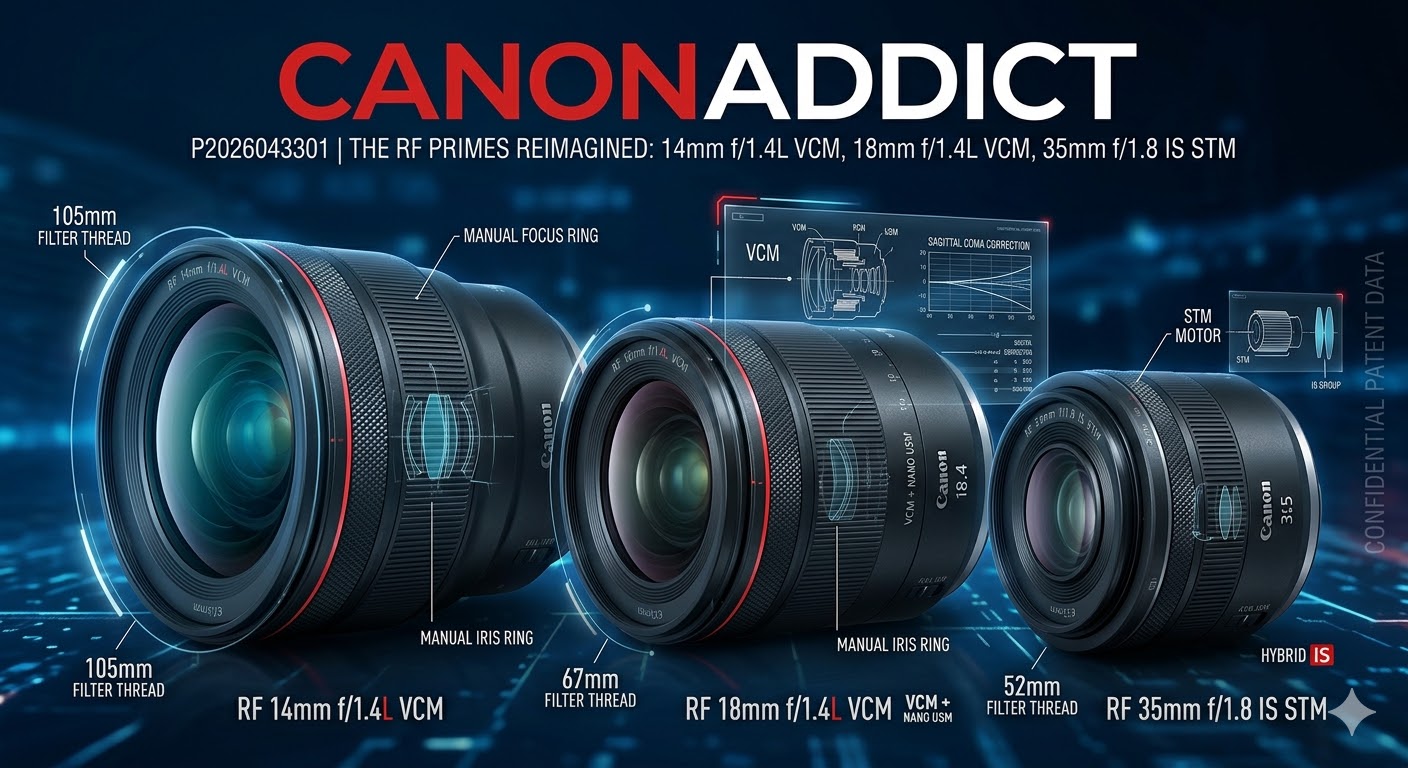
Canon Patent Reveals Possible RF 300mm f/2.0L and RF 200mm f/1.8L Lenses
A recent patent application by Canon (JP-2025-179579) has surfaced, detailing optical formulas for two incredibly fast super-telephoto prime lenses: a 300mm f/2.0 and a 200mm f/1.8.
These specs will be familiar to long-time Canon shooters. The EF 200mm f/1.8L USM, affectionately known as the “Eye of Sauron,” is a legendary lens. The EF 300mm f/2.8L IS USM is a staple of sports and wildlife photography, but a 300mm at f/2.0 is a different beast entirely, previously seen in the rare and expensive EF 300mm f/2.8L IS USM’s predecessor, the FD 300mm f/2.8L.
If these lenses come to fruition for the RF mount, they would be absolute behemoths in terms of both size and optical performance. Let’s take a closer look at the details.
The Optical Designs
The patent details two distinct optical formulas, which we’ll call Example 1 and Example 2.
Example 1: The 300mm f/2.0
This is the star of the show. A 300mm lens with a maximum aperture of f/2.0 is an engineering marvel. It would allow for incredibly fast shutter speeds in low light and produce a razor-thin depth of field, completely obliterating backgrounds.
Focal Length: 292.50 mm
F-number: 2.06
Half Angle of View: 4.23 degrees
Image Height: 21.64 mm
Lens Length: 350.13 mm
Back Focus: 13.50 mm
This lens design consists of 16 elements in 11 groups. As you can see from the lens block diagram below, it features a massive front element and a complex arrangement of glass to correct for aberrations.
Figure 1: Lens block diagrams for the 300mm f/2.0 and 200mm f/1.8.
Example 2: The 200mm f/1.8
This is a spiritual successor to the legendary EF 200mm f/1.8L. It’s a shorter, slightly faster lens than the 300mm, and it’s a favorite focal length for portrait and indoor sports photographers.
Focal Length: 195.00 mm
F-number: 1.85
Half Angle of View: 6.33 degrees
Image Height: 21.64 mm
Lens Length: 250.00 mm
Back Focus: 13.50 mm
This design is slightly simpler, with 14 elements in 11 groups, but it’s still a complex piece of optical engineering.
Optical Performance
The patent also provides aberration charts for these lenses. The charts for the 300mm f/2.0 (Example 1) show excellent correction for spherical aberration, astigmatism, and distortion, as you would expect from a high-end L-series lens.
Figure 2: Aberration charts for the 300mm f/2.0 lens.
Advanced Focusing System
A key feature mentioned in the patent is a sophisticated inner focusing system. To achieve fast and accurate autofocus with such large and heavy glass elements, the patent describes a mechanism where two separate lens groups are moved.
First Focusing Group: This group is located towards the front of the lens.
Second Focusing Group: This group is located further back, near the image plane.
By moving these two groups independently, the lens can achieve faster autofocus speeds and maintain high image quality throughout the focusing range, from infinity to close-up. This is a common technique in modern, high-performance telephoto lenses.
Figure 3: Cutaway diagram of the 300mm f/2.0 lens focusing mechanism.
Conclusion
While a patent filing is never a guarantee that a product will come to market, it’s exciting to see Canon researching such ambitious lenses for the RF mount. An RF 300mm f/2.0L or RF 200mm f/1.8L would be a dream come true for many professional photographers. They would be large, heavy, and undoubtedly expensive, but the optical performance and creative possibilities would be unmatched. We’ll be keeping a close eye on any further developments.
What are your thoughts? Would you be interested in either of these lenses? Let us know in the comments below!
For years, camera engineers have faced a massive design conflict, one we like to call the Heat vs. IBIS Paradox. On one hand, you want a powerful sensor that can shoot 8K video and high frame rates. This generates an immense amount of heat that needs to be moved away quickly to prevent the camera from shutting down. On the other hand, you want In-Body Image Stabilization (IBIS).
To make IBIS work, the sensor is literally suspended in mid-air on a movable stage, isolated from the camera’s chassis by magnetic fields and springs. This isolation breaks the natural path for heat to escape. The sensor becomes a “floating island” of heat with nowhere to go. This is why cameras like the EOS R5 required strict recording limits. Three new patent applications published on December 5, 2025 (JP-2025-176889, JP-2025-176890, and JP-2025-176965) show how Canon may have finally solved this problem.
The Solution: A High-Tech Thermal Bridge
Canon’s solution isn’t to add a bulky fan. Instead, they have re-engineered the connection between the floating sensor and the camera body. Each of the three patents addresses a specific part of this clever thermal bridge.
1. Creating the Path (Patent JP-2025-176889)
The foundation of the solution is described in patent JP-2025-176889. It introduces a dedicated “flexible member” that physically connects the “movable stage” (the part holding the sensor) to the “fixed base” (the camera’s chassis). Unlike standard ribbon cables that are designed only for data, this component’s primary job is to act as a heat pipe. By re-establishing a physical link, heat can now travel from the sensor to the camera’s large magnesium alloy body, which acts as a giant heatsink.
2. The Magic Material: Graphite (Patent JP-2025-176890)
A regular copper wire would be too stiff; repeated IBIS movements would cause it to work-harden and snap. Patent JP-2025-176890 solves this by specifying the use of a Graphite Sheet laminated with PET. Graphite is an incredible material for this application. It has extremely high thermal conductivity—even better than copper in some planes—but is pliable like fabric. This ensures maximum heat transfer without compromising the long-term durability of the stabilization system.
3. Perfecting the Mechanics with Slits (Patent JP-2025-176965)
Even a flexible graphite sheet could offer some mechanical resistance, which would make the IBIS motors work harder, drain the battery faster, and potentially reduce stabilization accuracy. Patent JP-2025-176965 provides the final piece of the puzzle: adding strategic slits (cuts) to the conductive sheet. These slits reduce the sheet’s spring constant, making it ultra-compliant. This allows the heat to flow freely while the sensor moves with zero added resistance, ensuring silky-smooth footage.
Why This Is a Big Deal
This is a passive cooling solution. It doesn’t require a noisy fan or the bulky camera body of something like the EOS R5 C. This technology suggests that future cameras, like a potential EOS R5 Mark III, could maintain the same compact, weather-sealed form factor as their predecessors while offering dramatically improved recording times. Canon seems to have found a way to have its cake and eat it too: pro-level video performance without the thermal baggage.
Godox announced its new Godox AD300Pro II Outdoor Flash.
Key Features
One-Tap Sync with Optional X3 Trigger
Compatible with Most TTL Systems
300Ws, 1/512 to 1/1 Power Output
Up to 350 Full-Power Flashes
Freeze Mode: 1/2310 to 1/24,390 sec
1/8000 sec High-Speed Sync
0.01-1.5 sec Recycling Time
16 Color Groups & Color Screen
12W Bi-Color LED Modeling Lamp
Includes Battery, Charging Cable & Bag
Pro Performance
Building on its predecessor, the AD300Pro II All-in-One Outdoor Flash from Godox arrives as the improved, second version of the popular AD300Pro—bringing several professional features and a more sleek design. Godox continues to expand its Witstro series by introducing the 300Ws AD300Pro II with 16 color groups, a convenient color screen, and a 12W bi-color LED modeling light. Another benefit is one-tap sync functionality with the brand’s separately available X3 trigger for easy synchronization. The AD300Pro II also brings a wider 1/512 to 1/1 power output in 0.1 increments, offering full TTL support to work with the auto flash systems of Canon, Nikon, FUJIFILM, OM SYSTEM, Panasonic, Sony, Leica, and Pentax cameras. The flash head has a recycle time of 0.1-1.5 sec, a handy action-stopping freeze mode, and finally, a lightweight 2.6 lb body that makes it a great asset for outdoor creators. Among its various acessories, the flash body comes with a reflector, battery, charging cable, and a carry bag.
Better Performance The AD300Pro II’s detachable battery will give you up to 350 full-power flashes with recycle times from 0.01 to 1.5 sec, a 10-stop power range, and high-speed sync times as short as 1/8000 sec. In addition, the AD300Pro II introduces a convenient freeze mode with flash durations from 1/2310 to 1/24,390 sec for stopping action. Outside of the freeze mode, the AD300Pro II has normal flash durations from 1/220 to 1/14,920 sec.
Improved Design Godox has improved the physical body of this flash, bringing a more elegant and modern design that enables intuitive local operation. Another unique AD300Pro II setting is its Color-Stable mode which maintains a consistent color temperature throughout the entire power range. At 5800K (+/-200K), the AD300Pro II is ideal for on-location portraits, editorial shoots, and other commercial work.
Effortless for Your Creative Shots Designed to simplify use when combined with the separately available X3 trigger, the AD300Pro II enables instant synchronization with the X3 to let you focus on your visual creation. This wireless sync function will optimize your photo workflow, cutting down the time you normally spend managing complicated channels and ID settings. Simply press the wireless sync option on both your X3 and the AD300Pro II to achieve quick synchronization.
16 Groups with Color Identification The AD300Pro II is part of Godox’s 2.4 GHz wireless X system with a range of 328′, featuring 16 groups, 32 channels, and 99 IDs that facilitate the use of multiple lights. Use the optional X3 or the XPro series, X2T, and X1 triggers to wirelessly control the flash head. The brand adds 16 color group capability so different colors will locally display on the flash head for easy group identification even from a distance.
Intuitive Settings In addition to the group color capability right at the head of the flash, the AD300Pro II body also has a color screen and a smooth metal control dial. Common functionalities of the flash are easy to manage thanks to an intuitive menu and local buttons. Besides that, it was clever of Godox to employ an upgraded bi-color LED modeling light that is now variable from a wider 2800 to 6000K range with adjustable brightness from 10 to 100%. The lamp has high CRI and TLCI ratings of 97 and 98, respectively. Use the LED modeling light for your previews or on-set illumination.
Widely Compatible The AD300Pro II has a proprietary Godox mount, but enables Bowens mount with the use of optional adapters. Meaning wide compatibility with optional light shapers from the Godox ecosystem and other types of modifiers, such as a snoot, a barndoor kit, a long focus reflector, a flash projector, and various softboxes. The AD300Pro II works with the separately available S3 or AD-AB adapters to expand your options with Bowens, Broncolor, Profoto, and Elinchrom mounts. This enables compatibility with optional beauty dishes, reflectors, a flash projection attachment, and quick release umbrella softboxes in different sizes and shapes.
Additional Details
Compact and highly portable at 7.36 x 3.94 x 3.54″
Wireless off flash mode for M/Multi
Wireless on flash mode for TTL/M/Multi
S1 and S2 modes
First curtain and second curtain sync modes
Stroboscopic flash up to 100 times, 100 Hz
0.01-30 sec flash delay
Mask, beep, and flash duration indicator settings
Battery level indicator and and power-saving auto-off functionality
3.5mm sync port for wired connection
USB-C port for firmware upgrades or 433 MHz connection with the optional Godox FR433
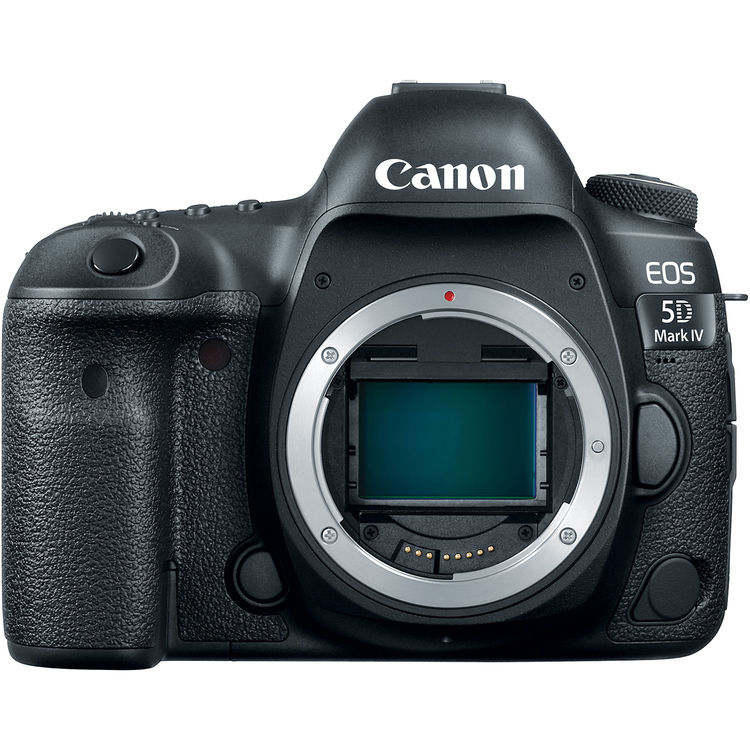
Canon still has a few camera registrations for cameras that haven’t been launched yet. You can find a list of them below, along with what cameras they might be, and generated images of them above.
Unknown Camera Registrations
DS126936 Wireless Spec: Wi-Fi 5 (802.11ac) + Bluetooth
What it might be:Canon EOS R7 Mark II.
Reasoning: Registered shortly after the R6 Mark III. The “DS” prefix denotes an interchangeable lens camera. Like the R6 III, it sticks to the robust but standard Wi-Fi 5 to differentiate it from the flagship R1/R5 series.
ID0179
Wireless Spec: Wi-Fi 5 (802.11ac)
What it might be:Canon EOS C70 Mark II or XF605 Successor.
Reasoning: The “ID” prefix is historically used for Cinema EOS or professional camcorders. This registration has been active since early 2024, suggesting a long development cycle typical of pro video gear.
ID0174
Wireless Spec: Wi-Fi 5 (802.11ac)
What it might be:PowerShot V10 Successor or VR Camera.
Reasoning: Another video-centric “ID” code. Canon is aggressively expanding the V-series for vloggers, which often use non-standard naming conventions internally.
New Wireless Patent Found US Patent 12,114,054: Communication Apparatus (Wi-Fi 6)
Description: A patent describing a camera capable of connecting to IEEE 802.11ax (Wi-Fi 6) networks. It details methods for managing power consumption while maintaining high-speed dual-band (2.4GHz/5GHz) connections.
What it might be:Canon EOS R5C Mark II or High-End Cinema EOS.
Reasoning: Since the R6 Mark III and R7 Mark II are limited to Wi-Fi 5, this patent points to a future high-bandwidth camera that requires Wi-Fi 6 for professional monitoring or massive video file transfers.